Why WhatsApp Marketing remains relevant in 2026
Cart abandonment continues to be one of the biggest challenges in e-commerce. According to the Baymard Institute, the average documented cart abandonment rate in online commerce is approximately 70%. This means that, in many cases, most consumers who show purchase intent do not complete the order.
This problem does not only happen because the customer lost interest. Often, the purchase is interrupted by doubts, distractions, shipping costs, price comparisons, checkout insecurity, or lack of urgency. When the store does not have a quick recovery strategy, some of these opportunities simply disappear.
It is in this context that WhatsApp Marketing gains relevance. The channel is already part of the routine of Brazilian consumers and allows more direct communication than email. But this does not mean that any message sent via WhatsApp will generate results. In 2026, the difference is less about “sending messages” and more about knowing when, to whom, and in what context the message should be sent.
The problem is not just the channel, but the timing of the approach
Many stores already use email marketing, automatic notifications, and manual customer service. These channels remain important but have clear limitations when the goal is to recover an ongoing purchase.
Email, for example, continues to be relevant for e-commerce automations. Klaviyo points out that abandoned cart flows are among the flows with the highest average order rate within the platform. Omnisend also shows that behavior-based automated messages, such as abandoned cart and welcome messages, generate a significant portion of automated sales.
In other words, email should not be discarded. The point is that it is not always the fastest channel for high-intent situations. When the customer has just abandoned a cart, a message sent at the right moment via WhatsApp can be more visible and actionable, especially if it takes the customer directly back to checkout.
Manual customer service can also convert well, but depends on team availability, training, and speed. During periods of high demand, messages pile up, responses are delayed, and opportunities are lost.
Generic chatbots solve part of the scale but often fail because they depend on rigid flows, poorly adapted responses, and low integration with the real purchase context.
When implementing WhatsApp Marketing is worth it
WhatsApp Marketing tends to be worthwhile when the store already has some traffic volume, recurring abandoned carts, and a contact base with permission to communicate.
It makes more sense in scenarios such as:
- stores that receive orders daily;
- e-commerces with frequent cart abandonment;
- operations that lose sales due to slow service;
- stores that already use WhatsApp manually but cannot scale;
- businesses that need to send order, payment, shipping, and post-sale notifications;
- companies that want to reactivate inactive customers with targeted campaigns.
In these cases, WhatsApp ceases to be just a support channel and begins to function as an active channel for recovery, relationship, and repurchase.
When WhatsApp Marketing may not be worth it
Despite its potential, not every store should start with WhatsApp Marketing. Implementation may not be a priority when the store does not yet have enough traffic, does not have a contact base with consent, cannot process orders regularly, or is still unclear about its offer.
It can also be a poor choice when the company intends to use WhatsApp only for mass and generic blasts. This type of use tends to generate rejection, blocks, and loss of trust. In 2026, automation via WhatsApp needs to be treated as a relationship and conversion strategy, not as a broadcast list without criteria.
What to do before implementing WhatsApp Marketing
Before hiring a tool or creating campaigns, the store needs to organize some basic points. The first is to ensure that communication complies with WhatsApp Business rules. Meta states that companies must obtain opt-in before sending messages via WhatsApp. Additionally, messages initiated by the company outside the service window must use approved templates.
The second point is to understand the costs. The official pricing of the WhatsApp Business Platform considers categories such as marketing, utility, authentication, and service, with charges per message delivered and variation depending on market and category. The third point is to map the main moments of the customer journey. For e-commerce, the most common flows are:
- abandoned cart;
- order created;
- payment approved;
- pending payment;
- order shipped;
- tracking code;
- inactive customer;
- re-purchase;
- segmented campaign based on purchase history.
Without this mapping, the company risks automating messages without strategy.
How to recover abandoned carts via WhatsApp
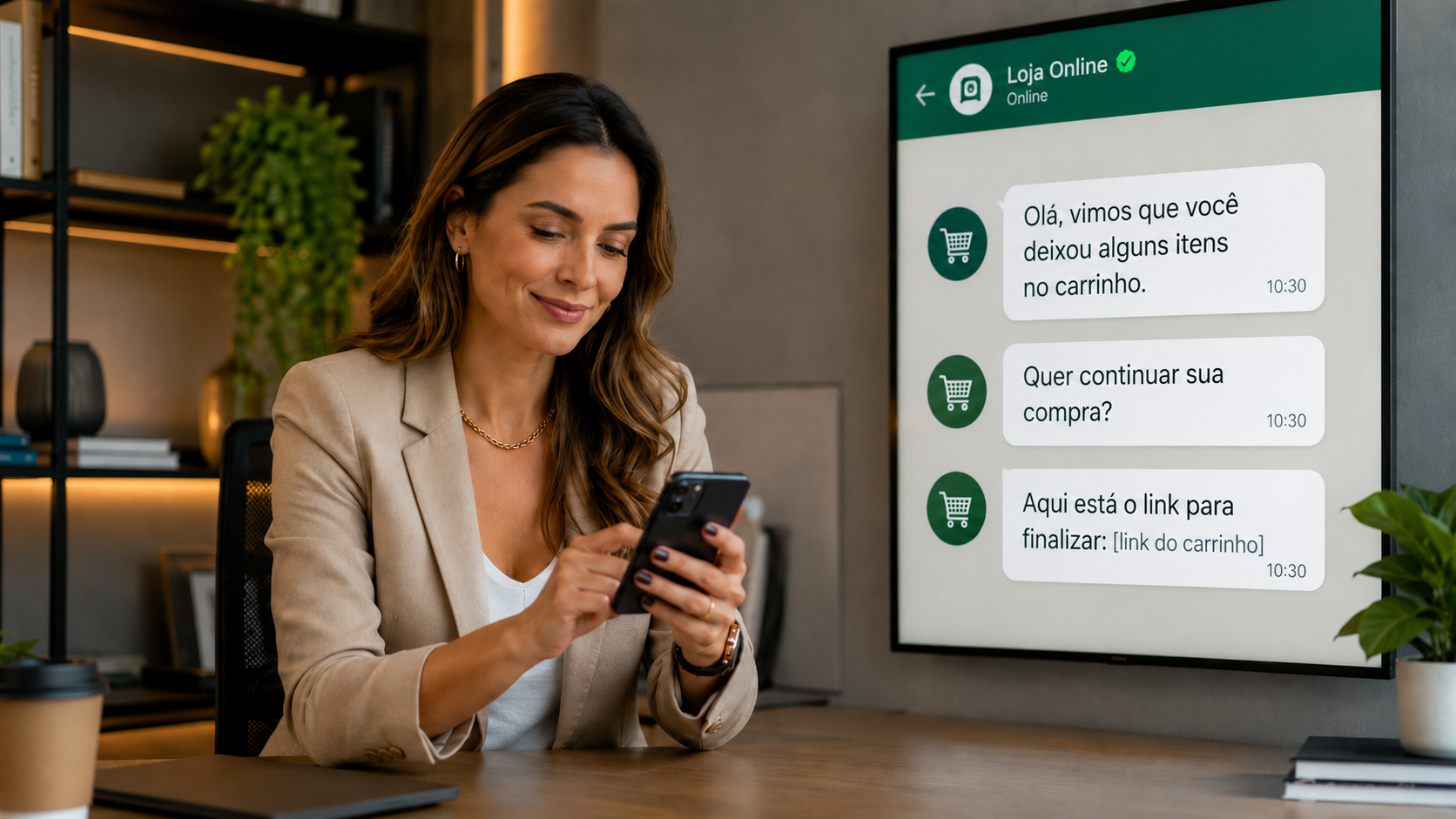
A good cart recovery flow does not need to be aggressive. It needs to be timely, clear, and useful. A simple example would be:
First message: 20 to 40 minutes after abandonment
Hello, we saw that you left some items in your cart.
Would you like to continue your purchase?
Here is the link to complete it: [cart link]
Second message: a few hours later, if no purchase is made
Your cart is still available.
If you have any questions about the product, payment, or delivery, we can help here.
Third message: the next day, if it makes commercial sense
Last reminder about the items you selected.
You can complete your order through this link: [cart link]
This flow should be adjusted according to the product type, average ticket, margin, and audience profile. In some cases, offering a discount in the first message can reduce margin without the need. In others, an incentive may be useful to unlock the decision.
What a good WhatsApp Marketing solution needs to have in 2026
When choosing a platform, the manager should evaluate practical criteria, not just commercial promises. A good solution should offer:
- direct integration with e-commerce;
- automatic triggers based on customer behavior;
- segmentation by purchase history;
- customizable messages;
- control of opt-in and opt-out;
- sending, click, and conversion reports;
- support for transactional notifications and campaigns;
- ease of configuration;
- monitoring of WhatsApp API changes.
The most important point is integration. If the platform requires exporting spreadsheets, importing contacts manually, or creating disconnected flows from the actual order, the operation tends to become slower and less reliable.
How to measure if WhatsApp Marketing is working
The analysis should not be limited to the open rate. WhatsApp naturally tends to have high visibility, but that alone does not mean increased revenue. The most important metrics are:
- recovered carts;
- recovered revenue;
- click-through rate on links;
- conversion rate after the message;
- cost per recovered sale;
- number of blocks or unsubscriptions;
- time saved in customer service;
- reduction of repetitive questions about orders and delivery.
The results should be evaluated by comparing periods, campaigns, and segments. For example, a store may discover that cart messages work best within 30 minutes, while reactivation campaigns need more specific offers.
Care to avoid appearing invasive
WhatsApp is a personal channel. Therefore, commercial use needs to be more careful than in other media. Some practices reduce rejection risk:
- send messages only to customers with permission;
- avoid excessive frequency;
- respect appropriate hours;
- make it clear how the customer can stop receiving messages;
- personalize content according to the context;
- avoid overly long texts;
- do not turn every interaction into a promotion.
Automation should make the customer's life easier. When the message helps complete a purchase, track an order, or receive a truly relevant offer, the channel tends to be perceived as useful. When the message is generic and repetitive, the opposite effect can occur.
Where WPP Marketing fits in
WPP Marketing is a solution from iN2 aimed at automating WhatsApp messages in e-commerce operations. Therefore, this article has a commercial relationship with the mentioned solution. Still, the criteria presented here are practical and verifiable: e-commerce integration, behavior automation, segmentation, operational control, and results measurement.
For stores that want to recover abandoned carts, send order notifications, automate reminders, and create segmented campaigns, WPP Marketing can be an appropriate option when the priority is to reduce manual effort and turn WhatsApp into a more active sales channel.
Is WhatsApp Marketing worth it in 2026?
Yes, it is worth it, especially for e-commerce stores that already have traffic, recurring orders, and opportunities lost due to cart abandonment or slow service.
But the results depend on how it is implemented. Using WhatsApp Marketing only to send generic promotions tends to be limited and risky. Using the channel with integration, context, permission, and measurement can turn WhatsApp into a relevant tool for sales recovery and relationship building.
In 2026, the most important question is not just whether WhatsApp Marketing is worth it. The right question is: is your store prepared to use WhatsApp in an integrated, responsible, and conversion-oriented way?
Try WPP Marketing for free
Want to see if your store can recover sales via WhatsApp? Discover WPP Marketing and learn how to automate abandoned carts, order notifications, and segmented campaigns without relying on constant manual customer service.
Start with a free trial and see how to turn WhatsApp into an active sales recovery channel for your e-commerce.